
67% Lose in Discovery. The Demo Jump That's Costing You $300K/Quarter
We analyzed sales calls to find what separates deals that advance from deals that stall.



Why is discovery so hard for me?
Before every sales call, I tell myself I'll slow down, ask better questions, and really listen.
Then the call starts.
The conversation gets uncomfortable. I feel pressure to prove value. Instead of digging deeper, I hit the easy button and start showing the product.
I know what I should be doing: uncovering a pain point and positioning WingRep as the solution.
But too often I show the product and hope the prospect helps me figure out where it fits.
I think it happens for three reasons:
- Discovery is unpredictable.
- Discovery is uncomfortable.
- And honestly, I'm often thinking about what I'll say next instead of fully hearing what the other person is saying.
Getting coached by our own AI coaches, Bonnie and Jeffrey, has made me painfully aware of this tendency.
As you'll see below, I'm apparently not alone.
-Amit, Founder, WingRep

You're reviewing a call recording. A first call with a prospect.
Rep asks: "So what's your biggest challenge with sales right now?" Prospect answers. Rep says: "Got it. Let me show you how we solve that." Jumps into demo mode.
15 minutes of feature walkthrough, and call ends. Prospect ghosted in a week.
When you listen back, you realize that the rep asked 2-3 questions max before pivoting to the demo. They never uncovered WHY it mattered. They never discovered the actual buying criteria. That's the real problem.
And your manager realizes this is happening on your team. A lot.
67% of deals you're going to lose this quarter are neither lost in the demo, nor in pricing negotiation, or faster competitor.
They're lost in the discovery call.
And the problem isn't that your reps don't know how to sell. It's that nobody is enforcing what actually works.
Let’s look at the Data
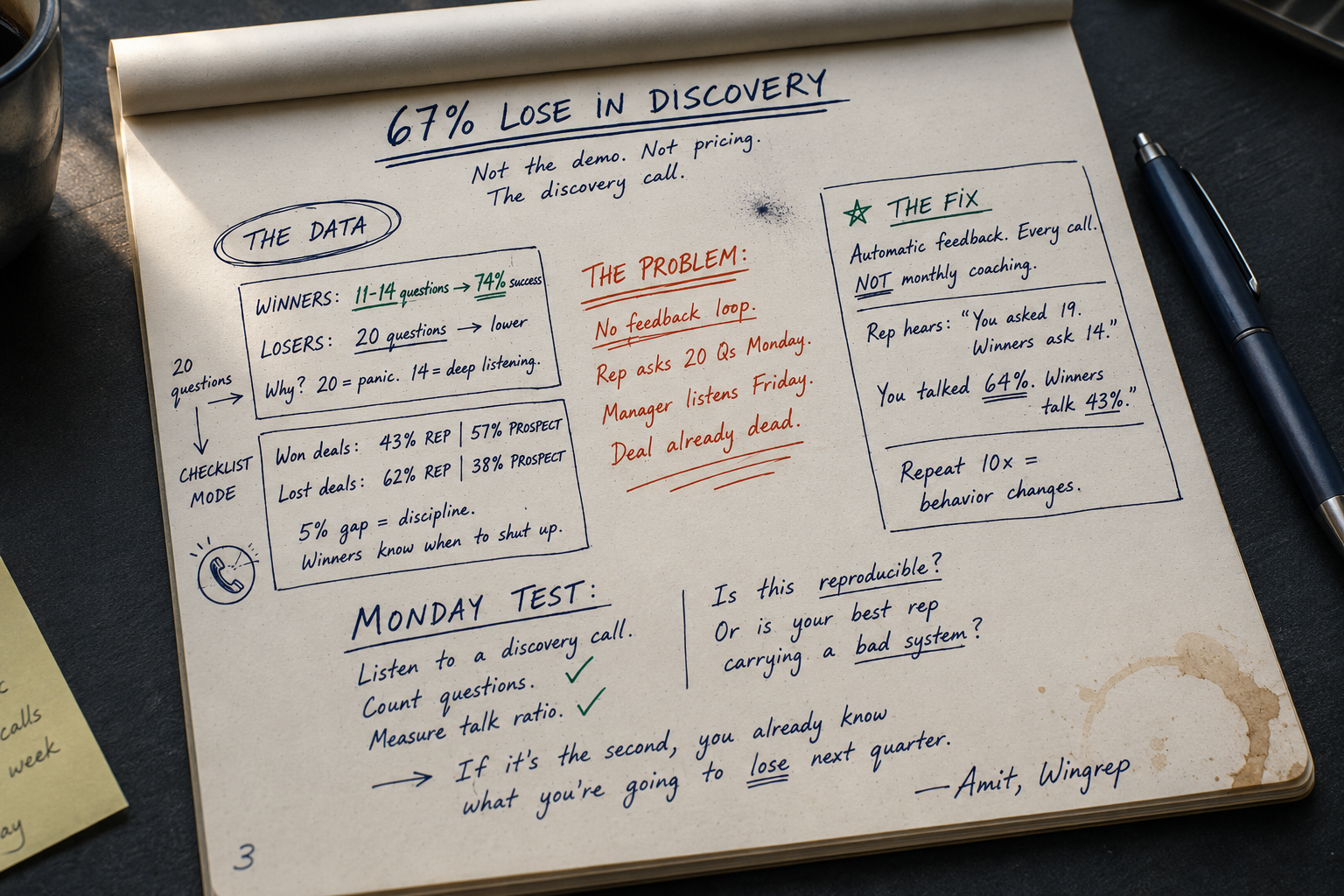
We looked at what separates the 74% of calls that move to the next stage from the ones that stall and die. This is the pattern we saw.
Question count.
WINNERS: Ask enough to understand the problem (11-14 questions), then listen and confirm before demoing.
LOSERS: Either ask 20 (checklist anxiety) OR ask 3 then pivot to demo
The pattern: 11-14 questions + deep listening + NO DEMO UNTIL READY = 74% success.
Talk ratio:
Won deals run about 43% rep talking, and 57% prospect talking.
Meanwhile, lost deals? It’s 62% rep talking and only 38% prospect.
Most people will think that the five-point gap is a coaching issue. But truly, it’s a discipline issue. It means winning reps know when to shut up.
Duration.
Top reps conduct discovery 76% longer. That doesn’t mean they're rambling.
It just means that they go deep on three answers instead of checking off a list. The sweet spot is ~38 minutes. That's enough time to uncover what actually matters. Less than that, you're skimming.
Why does this happen? Three reasons.
1) Reps are afraid. If they don't ask enough questions, they feel unprepared.
2) There's no structure. Without a playbook that says 'ask 14, not 20,' reps default to 'ask everything.'
3) There's no feedback. The rep asks 20 questions on Monday. Nobody tells them it's wrong until the deal dies six weeks later. By then, they've asked 20 questions on 15 more calls.
The Framework Part
Here's the part that kills me: when one team locks down a discovery framework and actually enforces it (not just as a suggestion in a coaching session, but as an automatic system on every single call), discovery effectiveness improves by up to 40%. Win rates lift 15–25%.
One framework. Enforced. That's the difference between quota and missing it.
But most sales orgs don't do this.
Instead, they print a PDF of questions, send it to the team, and hope. Or they do a one-off coaching session where the manager watches a call and says, "nice job asking deeper questions, keep it up." Then the rep goes back to asking 20 questions on the next call because there's no feedback, no enforcement, no system.
The best reps ask better questions because someone (or something) gives them feedback on every single call, within hours. And not at a pipeline review. The rep hears: "You asked 19 questions today. Winners ask 14. You talked 64% of the call. Winners talk 43%." Repeat that 10 times, behavior changes.
What Comes After
The discovery call is half the battle. The other half is what comes after.
That's where WingRep fixes the leak.
See it in action
We know that discovery isn't just the call. It's what happens after the call ends.
The rep hangs up. Now what? A real discovery call needs:
- An automated qualification recap that maps what you heard to your framework (MEDDICC, BANT, whatever you use)
- A follow-up email that's actually written, the meeting prep email that surfaces what matters most
- A CRM entry that's pre-populated, not manually typed at 6pm
- Feedback on what the rep did right and what to do differently on the next one
Right now, most orgs ask the rep to write all of that themselves. So it doesn't happen. The prospect hears radio silence. The CRM stays empty. The manager doesn't know what was actually uncovered.
The rep does the work twice, once on the call, once in admin busywork. And discovery becomes a sales black hole instead of a predictable stage.
The Monday Test
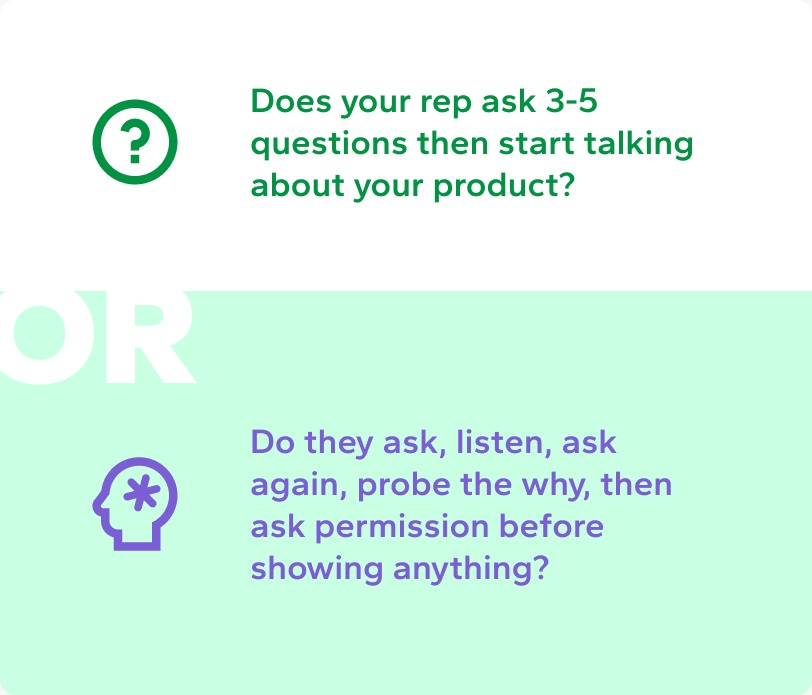
Next Monday, here's what to listen for:



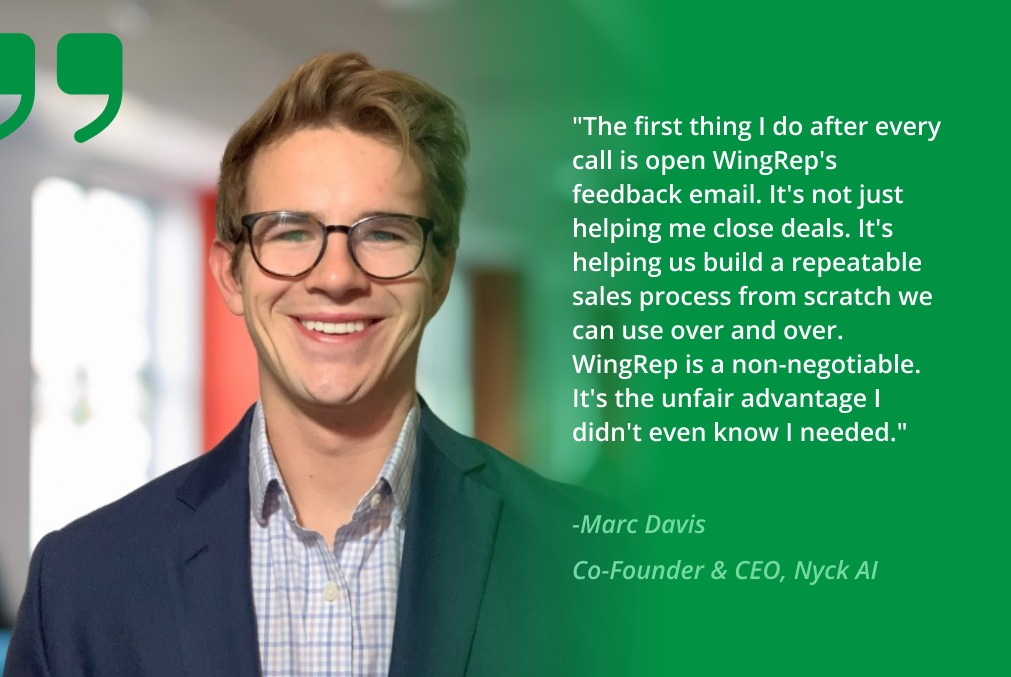
Marc's right. The reps who win aren't smarter. They just have feedback that changes their behavior fast.
Every call you're missing that feedback is a deal you're leaving on the table.
Wingrep's job is simple: give you that feedback within 2 hours and not 2 weeks.
When discovery works automatically, everything else follows. Your unfair advantage shows up. That's the move.
Catch you next week,