
The Ramp Tax
Why your new AE won't pay for themselves until Q3.


I've spent a lot of time interviewing college students lately, and it’s been fun.
What surprised me wasn't how much they had to learn. It was how much they taught me.
My favorite question to ask was “teach me how to do something useful with AI.” One of them built a tool and sent me a link, unprompted, in their thank you email.
At the same time, many are completely unfamiliar with concepts experienced salespeople take for granted.
I asked one candidate to tell me about her prospecting experience.
Blank stare, even though she had spent the last year recruiting local businesses to sponsor her student organization! She just didn’t know the word for it.
The next generation entering the workforce may have less experience, but they also have fewer assumptions about how work is supposed to be done.
And in an AI-driven world, that might be a bigger advantage than most people realise.
-Amit, Founder, WingRep

You hired an AE in December.
It's June now. Six months in.
Let’s walk through exactly what you got.
- Weeks one and two: product training, shadowing calls, learning the CRM fields nobody uses.
- Week three: first solo discovery calls, shaky but fine.
- Month two: pipeline starting to appear.
- Month three: a few deals in stage two, one real opportunity that looks promising.
- Month four: the promising opportunity goes dark.
- Month five: quota review.
- Month six: you're having a conversation about whether this person is going to make it.
The number they've generated against their quota in six months is somewhere between 20 and 40 percent of what a fully ramped rep would have produced.
You didn't budget for that gap. Nobody does. But everybody pays it.
The Math Nobody Runs
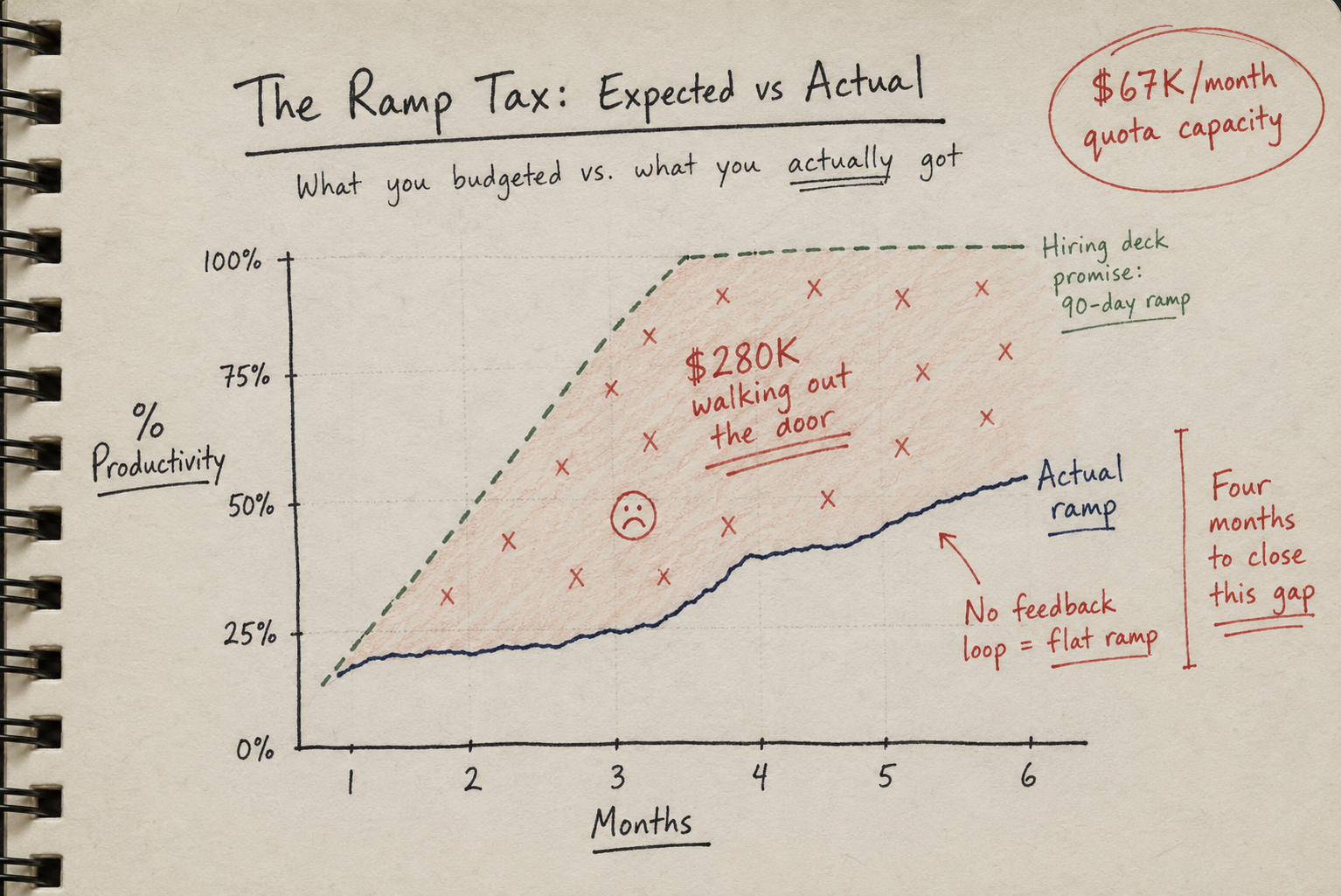
The Bridge Group's SaaS AE benchmarks put average ramp to full productivity somewhere between three and six months, and that's for orgs that invest in structured onboarding.
For mid-market companies without a dedicated enablement function, six to nine months is common. Reddit threads from sales managers say: "We say three months, it's actually closer to eight before they're really contributing."
Here's what that costs, done simply.
Say your AE carries an $800K annual quota, the 2025 median for a SaaS AE.
That's roughly $67K per month in quota capacity.
A six-month ramp at 30% average productivity means you collected about $120K of that $400K potential.
The other $280K walked out the door as a lost runway.
On paper, you hired a rep. In reality, you absorbed a $280K productivity deficit before they ever had a quarter.
For an enterprise company running a $200M number, that's a rounding error. But for a Series B with 14 AEs and a board asking why Q3 came in at 47%, it's part of the answer to the question everybody’s asking.
The Four Factors That Make Ramp Longer Than It Should Be
Most ramp problems are blamed on the rep. Almost none of them are actually the rep's fault.
1) No pre-call context, ever. New reps spend the first 60 days figuring out how your best reps actually think before a call, not the training doc version, the real version.
What questions do they open with? Where do they slow down? What signals do they listen for? That knowledge lives in the heads of two people who don't have time to share it.
2) Coaching that runs on manager availability. The math from above applies here double: a manager with 12 reps has roughly 16 minutes per rep per week if they're lucky.
A new rep needs more than that, not less. What they actually get is a 30-minute bi-weekly 1:1 and a lot of Slack messages asking ‘how's it going.’
3) CRM data that doesn't reflect reality. The new rep inherits an account list, a pipeline, and a set of historical notes that are partially wrong, partially outdated, and mostly incomplete.
They spend weeks building a picture of accounts that a fully ramped rep already has in their head. Every bad CRM field is a week of the rep reinventing wheel.
4) No feedback loop after calls. The most important learning in sales happens in the 10 minutes after a call ends. What worked, what didn't, what the rep would say differently next time.
For a new rep, that debrief is either self-administered (unreliable) or happens in a 1:1 four days later (too late to stick). By the time the feedback arrives, the rep has done six more calls the same way.
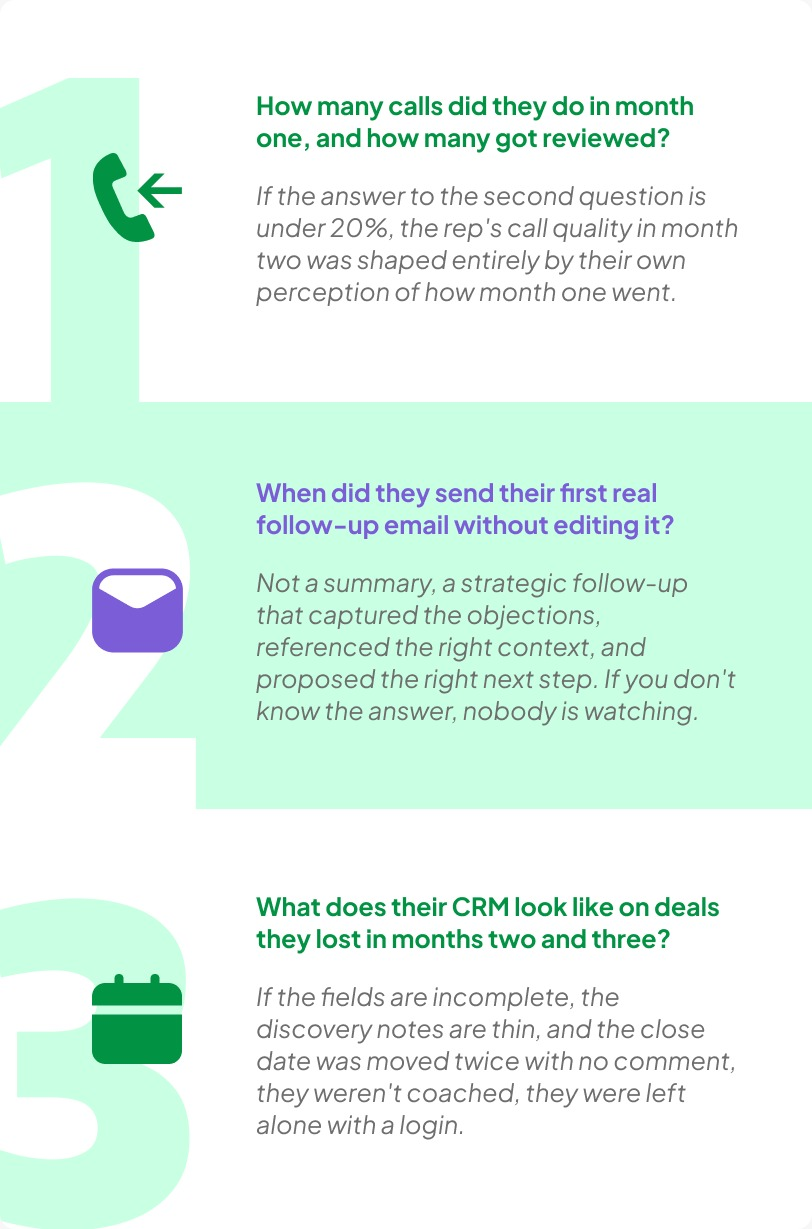
A Ramp Audit for Your Team
The One Intervention That Cuts Ramp Fastest
Training is not the answer.
Training is how you tell a new rep what a good call looks like. That's not the same as showing them what a good call feels like, in real time, with their actual customers.
The fastest ramp happens when the new rep gets a detailed, specific debrief within minutes of every call, not a summary of what was said, a coaching note on what worked and what should have been different, calibrated to the specific deal, the specific moment in the sales cycle, and the specific rep's pattern.
That used to require a manager who had watched the call.
Most managers haven't watched the call. They're in a pipeline review.
The orgs that are cutting ramp times, not to the aspirational 90 days everyone puts in their hiring deck, but meaningfully, from seven months to four, are the ones where the feedback loop closes automatically, after every call, without waiting for the next 1:1.
More than a training investment, it's a workflow one.
And the difference between a rep who ramps in four months and one who ramps in seven is compounding.
Every month earlier is $67K of quota capacity you didn't leave on the table.

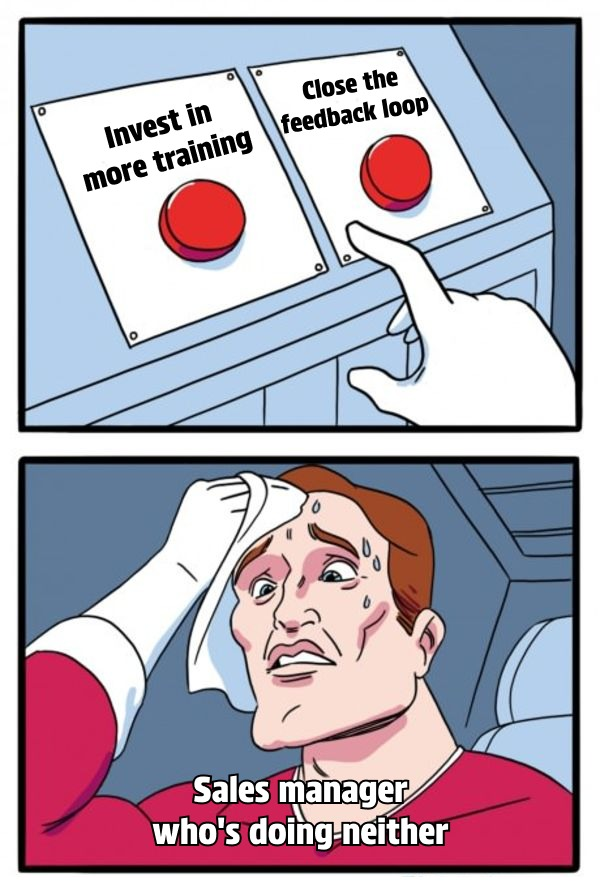

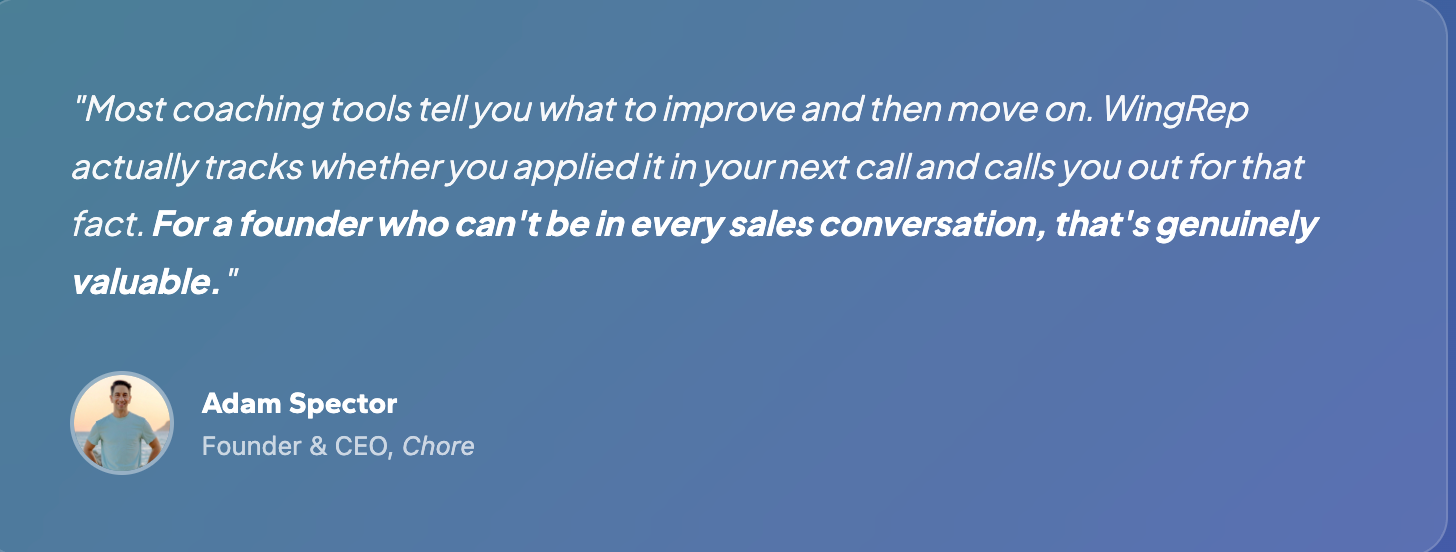
Most teams run a training session or a coaching call, assume the rep will apply it, and move on. But reps don't change behavior from being told what to do. They change from being forced to confront whether they did it.
As Adam's point goes: other tools diagnose the problem and walk away. The leverage move is tracking whether the rep actually applied the feedback in the next call. That's the difference between a coaching note and a coaching system.
That's what turns a seven-month ramp into a four-month one. Not more meetings, but speed.
If you want to see how the feedback loop closes for your team, and what it does to your ramp timeline, let's walk through it.
Catch you next week,