
Your Note-Taker Isn't Your Coach
A summary doesn't tell your reps what to do next.



I had a great time at the RevOpsAF conference in San Francisco this month, put on by the RevOps Coop.
It’s a great community of RevOps practitioners sharing their learnings from the field, using the latest AI tools - and many of them have something in common - they love WingRep!
It was incredible to meet so many WingRep users for the first time in person, including Aliza Kogan, Cliff Simon, Arriel Balogun, and McKenna Sivula. I posted about it here and here, just in case you’re interested.
-Amit, Founder, WingRep

It's 4:47 PM on a Thursday. Your AE just walked out of a 45-minute demo with the Head of People at a 600-person company.
The call went well. Prospect was engaged. She asked good questions. At minute 31, she said: "I love it. I think my team will love it. Let me take this back to my CFO."
The AE walks out feeling great. An hour later, an AI call summary is dropped in the inbox.
Key Takeaways: Prospect shared that… Topics: Integration with Workday and existing HR systems…
The AE drops it into Salesforce. Books his next call. Moves on.
Four weeks later, no reply. Six weeks later, she's ‘evaluating other options.’ Eight weeks later, gone.
Here's what everyone missed: she said "I think my team will love it," not "they will." She said "let me take this back to my CFO," not "let me bring you in to meet my CFO." She handed the AE a polite exit.
But the AI didn’t flag anything. Because she seemed engaged and asked good questions.
No system on the AE’s stack told him: you got handed a soft no, go back in the next 48 hours and ask for CFO access, or this deal is already dead.
The Math Your VP of Sales Should See
After a discovery call ends, an AE is supposed to do roughly 12 things in the next 24-48 hours.
Send the follow-up email with a clear next step. Update MEDDIC fields in the CRM. Update deal stage and close date. Log every objection raised and a written response to each. Create dated next-step tasks. Multi-thread to any new stakeholder named on the call. Update contact records. Send promised collateral. Loop in their manager, SE, or CS team. Run a commitment test. Self-coach on the call. Re-rank the deal in the forecast.
Now look at what your note-taker; Read, Chorus, Fathom, Fireflies, pick your poison, actually executes.
It drafts the follow-up email. It captures contact names mentioned.
That's it. 2 out of 12.
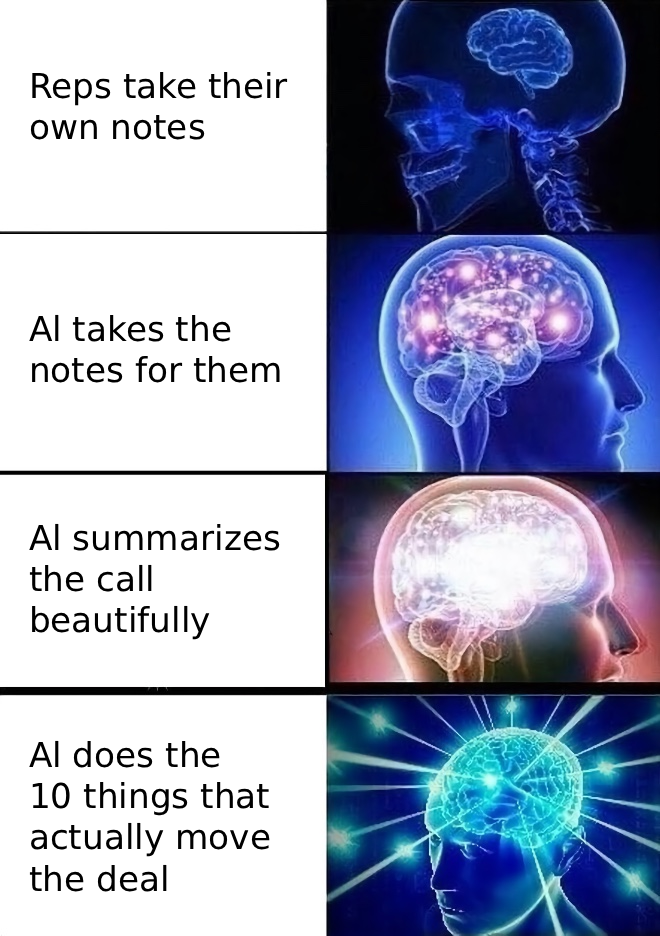
The other ten, including the highest-leverage ones, multi-threading, commitment tests, objection responses, dated next-step tasks, internal handoffs, depend entirely on whether your rep, on their own, in the hour after a draining call, decides to do the work.
The Buying Habit Showing Up Again
Last time we talked about the QBR pattern. Leaders buy visibility because visibility is what gets reviewed at the board meeting. Note-takers are the same buying habit, in a deeper way.
You bought a tool that watches the call. The pitch was: "your reps will get better."
But they didn’t. 75% of sales teams report their sales cycles are the same length or longer after adopting AI tools. AEs still spend 28% of their week actually selling. Forecast variance still runs at 38%. MEDDIC field completion still sits around 42%.
The tools accelerated the broken processes, rather than fixing them.
The Three Execution Moments That Save Deals
Pull the last ten deals you lost. Read the call summaries on each.
Every one of them summarized the objection that killed the deal.
The summaries weren't wrong. The follow-through was missing.
Here's what should have happened:
Moment 1: The 24-hour objection response.
Within 24 hours of the call, the rep sends a written, specific response to every objection raised. Not a ‘great talking to you’ follow-up
Your note-taker logs the objection. It does not assign it, time-box it, or create a forcing function. Logging an objection in Salesforce and responding to it in writing within 24 hours are two different sports. One is bookkeeping. The other is selling.
Moment 2: The multi-thread trigger.
Within 72 hours of any call where a second decision-maker is named, CISO, CFO, Legal, Procurement, the rep either gets a calendar hold with that person or escalates internally that they can't. No exceptions.
Your note-taker writes ‘Next Steps: loop in CISO.’ It does not tell the rep that if the CISO isn't on a calendar by Friday, the deal's probability should be cut in half.
Moment 3: The commitment test.
Before the rep believes the prospect is moving forward, they run a small, specific commitment test. "Can you intro me to your CFO this week?" "Can we get 20 minutes with Legal before Thursday?" "Can you send me the security questionnaire by Monday?"
Your note-taker can't run this test. AI sentiment scores reward warmth, smiles, nods, engaged questions. They can't tell the difference between a prospect who's enthusiastic and a prospect who's committed.
This is one of the gaps WingRep was built to close.
Note-takers stop at the summary. WingRep starts there.
Imagine an AI sales coach that sits inside every call your reps run, then does the work that should happen after the call. Drafts the follow-up email, and tailors it to the objections actually raised. Writes to your CRM, fills in MEDDIC, captures the qualification framework, logs the next steps. Surfaces the commitment test the rep didn't run. Flags single-threaded deals before they stall. And gives every rep their own coach, the same Jeffrey Gitomer who wrote the best-selling sales book of all time, in AI form, preparing them before every call and debriefing them after.
Your reps get a wingman. Your managers get coaching that scales to all 15 reps without burning their week.
That's the difference between an AI that watches your team work and an AI that works for your team.
The Monday Test
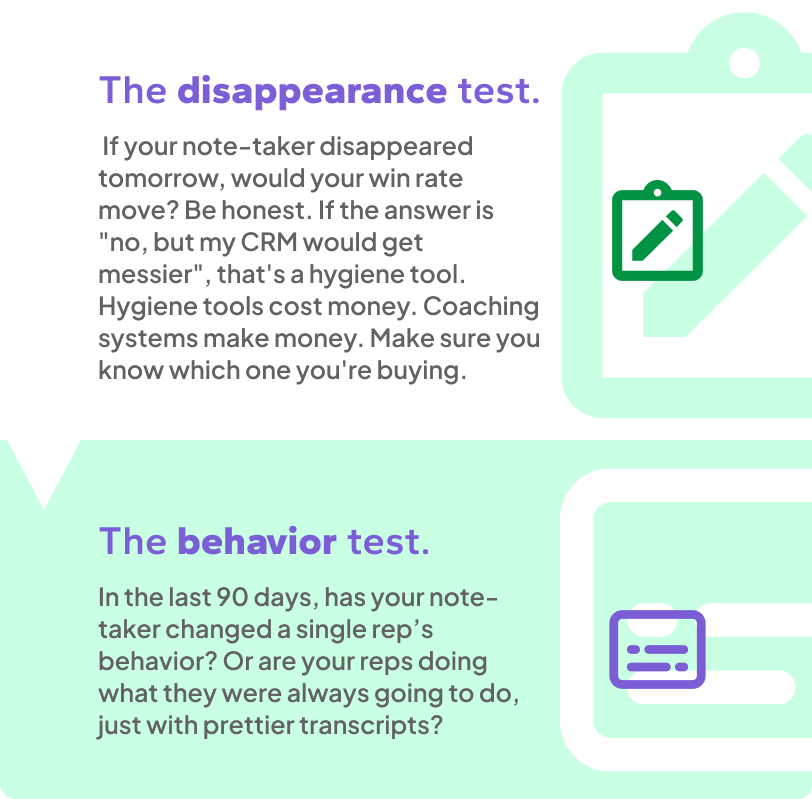
Two questions.

Relatable?

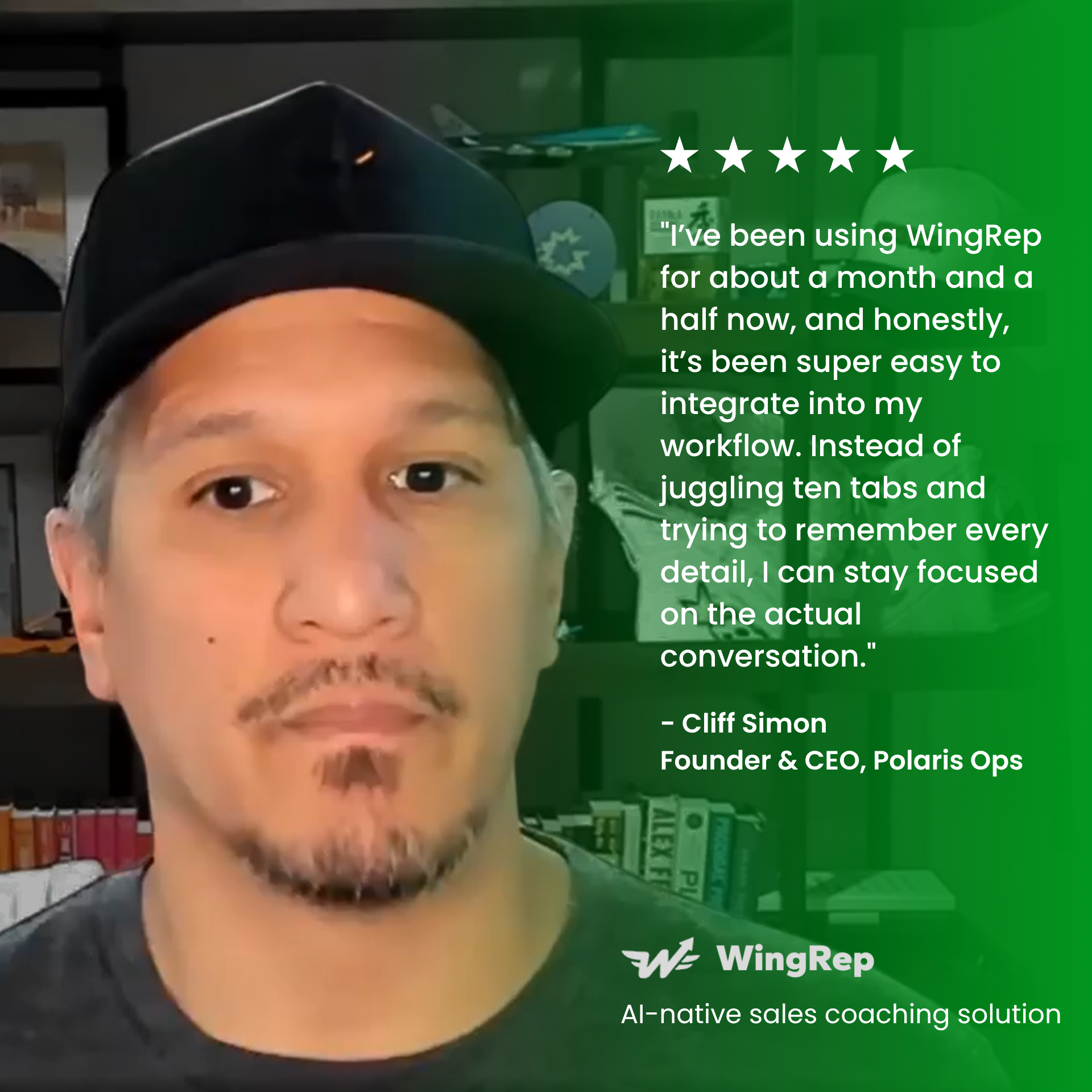
Ten tabs down to one conversation.
That's what happens when your AI stops watching and starts working. No more switching between Salesforce, the note-taker, the follow-up draft, the next-call prep, and the seven other tabs your reps had open before the call even started.
Cliff didn't get there by adding another tool to his stack. He got there by replacing the ones that weren't pulling their weight.
If you want to see what that looks like for your team, book a 15-minute consultation call with us.
Would love to walk you through it:
Catch you next week,