
More Tabs. Less Selling.
Your reps shouldn't be the integration layer.



Earlier this week, I asked salespeople a simple question: How many browser tabs do you have open before a customer call?
The responses weren't surprising. Most people had a lot. What surprised me was that nearly every tab was there for a good reason.
CRM. LinkedIn. Email. Calendar. Slack. Conversation intelligence. AI tools.
None of these are bad products. In fact, most are excellent. But when you step back, it's worth asking: when did selling become a job of managing software?
The best reps aren't necessarily the ones with the best tools. They're the ones who can navigate all the tools without losing focus on the customer.
Maybe the next wave of sales technology isn't about adding another tab. Maybe it's about eliminating a few.
-Amit, Founder, WingRep

It's 9:12 on a Tuesday. One of your AEs has her first call at 9:30.
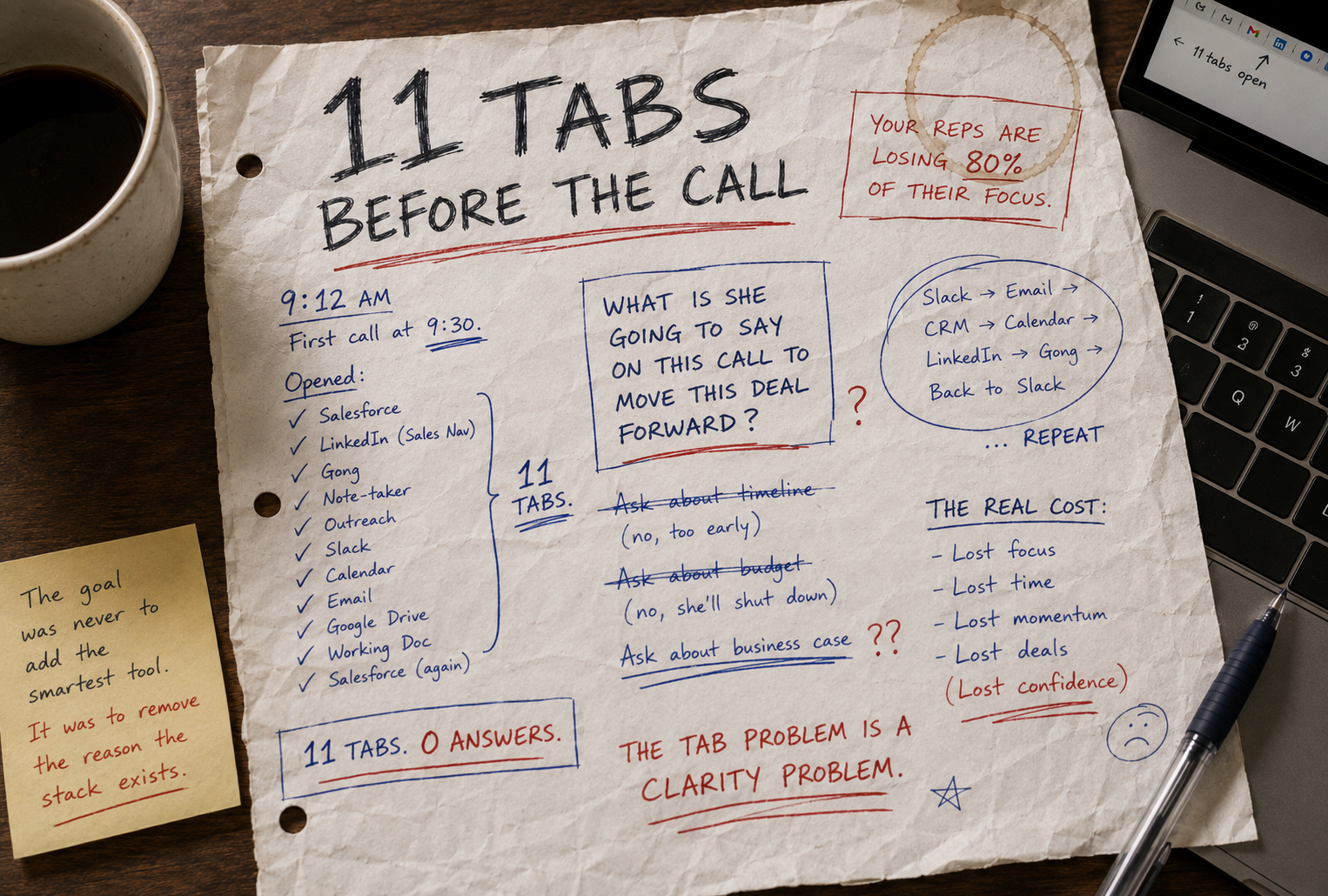
She opens her laptop. Salesforce, to pull up the account. LinkedIn Sales Navigator, to check whether anyone new joined the buying committee. Gong, to skim the last call. The note-taker dashboard, because the summary lives there, not in Gong. Outreach, to see if the prospect opened the sequence. Slack, to ask the SE a quick question. Her calendar. Her email. The deal's working doc in Google Drive. Then back to Salesforce, because she still hasn't found the renewal date.
By 9:30 she has opened eleven tabs and answered zero of the only question that actually matters: what is she going to say on this call to move this deal forward.
She joins a minute late. Slightly behind. She wasn’t unprepared but she spent her prep time being a router between nine systems that don't talk to each other.
The Math Your VP of Sales Should See
Your reps use 8 tools on average to close a deal (Salesforce, State of Sales).
Each one was approved on its own merits. Each one has a defensible ROI story.
- The CRM has an ROI.
- The dialer has an ROI.
- The note-taker has an ROI.
Now add them up.
As per Harvard Business Review, The average digital worker toggles between apps and windows roughly 1,200 times a day. about once every 24 seconds.
Every switch carries a tax: it takes around 9.5 minutes to get fully back into flow after moving between applications (Cornell / Qatalog).
And the selling time itself? A B2B rep spends about 23% of the work week actually selling. On a normal week, that's roughly eleven hours in front of customers.
The other thirty-plus are spent being the integration layer the software was supposed to be.
42% of your reps will tell you they feel overwhelmed by the number of tools they're handed. Those overwhelmed reps are 45% less likely to hit quota .
Read that again.
The Same Buying Habit, One Layer Down
Last week we talked about the note-taker, how it does 2 of the 12 things a rep should do after a call. The most common reaction we heard back was, in effect: "So I need a tool that does the other ten."
Stop right there.
Outreach wrote in January that "the eight-to-twelve tool sales tech stack is dying." 84% of sales teams without an all-in-one platform say they plan to consolidate.
But here's the question nobody asks honestly: when you "consolidate," is your rep actually opening fewer tabs, or just opening one bigger tab, with the same nine jobs still sitting unfinished inside it?
Consolidation that still requires the rep to show up, log in, and do the work is the same stack. Just with a nicer login screen.
The Three Questions to Ask Any Vendor
Before you approve the next tool, AI or otherwise, run it through three questions. They take thirty seconds and they'll kill most of your potential purchases.
1. Does this give my rep a new tab? If your rep has to remember to log in somewhere new, you have just relocated the work. A tool a rep has to visit is a tool a rep will skip on a busy Thursday. And Thursdays are always busy.
2. Does it do the work, or just show me the work? A dashboard shows. A system of action does. If the output is a screen that someone still has to read and then act on, you just bought a report. (We made this whole argument two editions ago. It applies to every tool in the stack, not just the note-taker.)
3. Does it still work when the rep doesn’t focus? The best sales software is invisible. It runs whether or not the rep is thinking about it. If adoption depends on rep discipline, adoption will fail even if the tool is good, because discipline is the first thing a quota crisis burns through.
Most tools in your stack fail at least two of these. Some fail all three and still renew every year.
This is the gap WingRep was built around. WingRep sits inside the call your rep is already on, and with our desktop app, soon with no visible bot at all.
It gives you your gameplan for each call, nudges you with a few hints during the meeting, and then it does the work: drafts the follow-up tailored to the objections actually raised, writes to your CRM, fills the MEDDIC fields, logs the next steps, flags the deal that's gone single-threaded before it stalls.
Your rep never logs into WingRep. WingRep comes to your rep.
The goal was never to add the smartest tool to the stack. It was to remove the reason the stack exists.
The Monday Test
Two things to do on Monday.
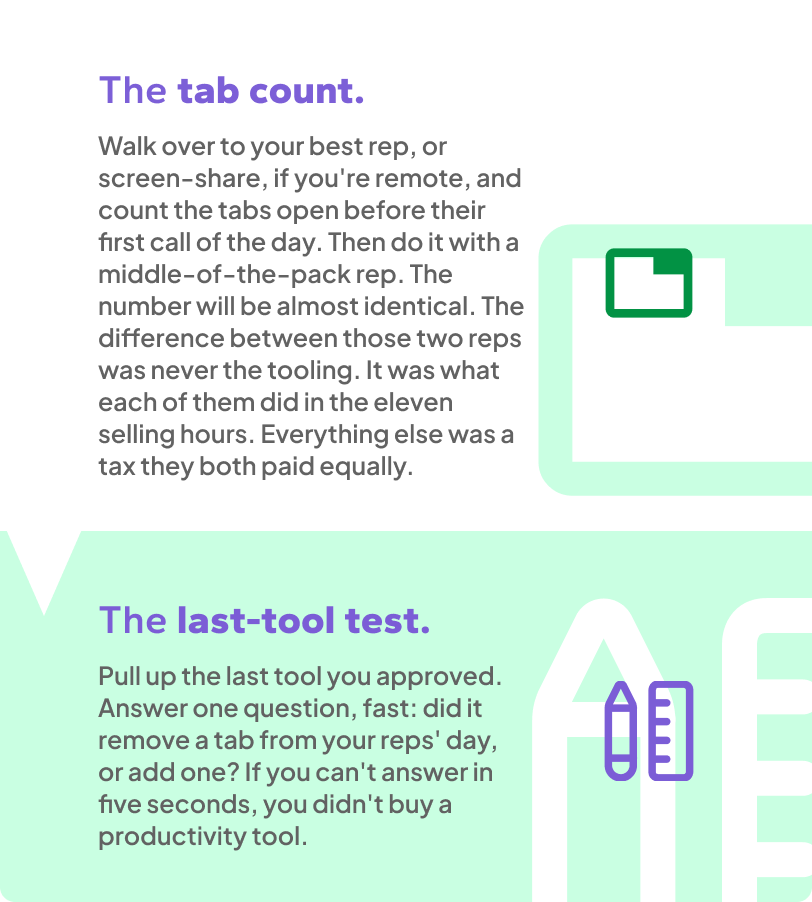

If your team is carrying 8+ tools and you want to see what removing the reason for half of them looks like:
Catch you next week,